System Integrators build what you ask for. I make sure you are asking for the right thing.
Independent quality assurance on the Finance design of your S/4HANA program, for CFOs and program managers. Before build, during build, and at the first close. With or without a System Integrator.
15 minutes, instant result, no sales call attached.

years in SAP Finance
S/4HANA programs

SAP Press author
QA seats maximum
Clients I have worked with














Who I work with
CFOs and finance leadership
You sign off on the numbers after go-live. I make sure the design behind them is right, and I put my opinion in writing so there is a paper trail behind every key decision.
Program and transformation managers
You own the timeline and the risk register. Design questions get an answer within one business day, so decisions do not sit open for weeks and flaws surface before build.
Finance teams on a live system
Live on S/4HANA or ECC, no System Integrator on site, and a backlog of design debt. A senior architect on call, without hiring one.
How I work with you
Three steps. Most clients take them in this order, and each one tells you whether the next one is worth it.
- 1Today
Free Finance Readiness Assessment
About 15 minutes. Your Finance design scored across five areas, risks ranked on the spot. No sales call attached.
You get
- a traffic-light score
- a ring per area
- your top five risks
- 2Before build
Finance Design Review
One independent review of your blueprint before it is built. I read the whole value flow, not only the Finance corner.
You get
- risk-ranked findings
- a clear go or fix list, in writing
- 3Through the program
Quality Assurance seat
A standing seat next to your program until the first close is behind you. Flat monthly fee, used or not. Eight seats in total.
You get
- every design question answered within one business day
- a monthly QA session
- my written opinion behind every key decision
- the Quality Assurance Portal, where you follow every finding, my opinion and the readiness of each tollgate
Specialist Resourcing
Need people rather than a verdict? I place senior SAP consultants I have vetted myself, Finance and the modules around it. They work to the same design standards I audit against.
What I check, and when
The parts of the Finance design where programs lose data integrity and only find out at the first close. Most of those postings come from logistics, sales, procurement, production and projects, so I check the whole value flow, at the point where each decision is still cheap to change.
- Explore · Cheapest point to fix
Design decisions
Enterprise structure, chart of accounts, ledger model, document splitting, Margin Analysis.
What the program produces
- enterprise structure blueprint
- chart of accounts and account groups
- ledger and currency model
- document splitting characteristics
- operating concern and characteristics
- key design decisions
Where it goes wrong: decisions are taken module by module. The profit center and segment design follows the material master instead of how the business is steered, and the chart of accounts serves one country. Every later fix is a migration.
What I check
- Company code, plant, controlling area and operating concern assignments against the legal and the management structure
- One operational chart of accounts, with group and country charts where local GAAP needs them
- Profit center and segment design, functional areas, and the splitting characteristics with their zero-balance and mandatory settings
- Leading, non-leading and extension ledgers, the accounting principle and the currency types each one carries
- Margin Analysis characteristics and the derivation rules from customer, material and sales order
- Realize · Where I spend most review time
Build and integration
Account determination, costing, allocations, asset accounting, settlement.
What the program produces
- account determination
- costing and valuation variants
- allocation cycles
- depreciation areas and asset classes
- order types and settlement rules
- results analysis
Where it goes wrong: most postings in the Universal Journal are created by goods movements, invoices, deliveries, confirmations and settlements in MM, SD, PP, PS and PM/CS. Programs leave this to the logistics workstreams, and nobody checks that inventory, cost of sales and the P&L still agree.
What I check
- Account determination for goods movements, invoice verification and billing, valuation classes, price control per material type, and GR/IR clearing
- Purchase order account assignment, invoice variances, accruals, consignment and subcontracting flows
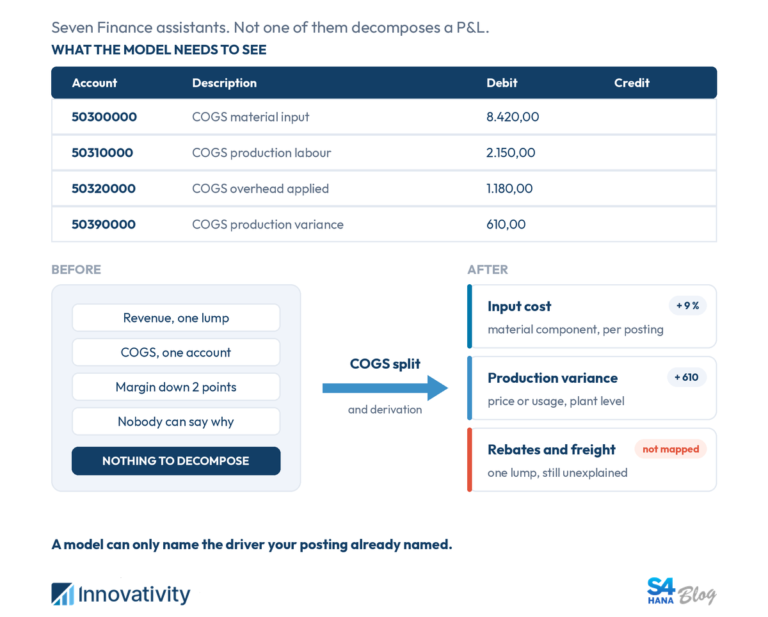
- Pricing conditions to revenue and deduction accounts, event-based revenue recognition, and the cost of goods sold split by cost component
- Order types, work in process, variance categories, results analysis and settlement rules for production, PM/CS and WBS elements
- Costing variants, the cost component structure, Material Ledger activation and the actual costing run
- Assessment, distribution and activity allocation cycles, and which allocations run in universal allocation and which in PaPM
- Depreciation areas per ledger, asset classes, capitalisation thresholds, assets under construction and investment orders
- Deploy · Hard to change after go-live
Cutover and migration
Open items, inventory values, open orders, fixed assets.
What the program produces
- migration objects and reconciliation reports
- cutover plan
- open item and balance migration
- asset migration
Where it goes wrong: open items land without document splitting, inventory migrates without its Finance values, and the first balance sheet by segment does not reconcile. Nobody notices until the period is closed.
What I check
- Migration of open items with document splitting active, so the first balance sheet by segment reconciles
- Open purchase orders, sales orders, production orders and inventory values migrated with their Finance values intact
- Asset migration per depreciation area and accounting principle
- Fiscal year variants, posting periods and the close steps that depend on them
- First close · Here is where programs find out
The first close
Period-end sequence, intercompany, group reporting.
What the program produces
- the first month-end
- intercompany reconciliation
- the feed to group consolidation
Where it goes wrong: every earlier shortcut surfaces here, at once. Intercompany loses days, segment reporting turns into a monthly reconciliation exercise, and the close becomes a search instead of a schedule.
What I check
- The period-end sequence: foreign currency valuation, reclassification, accruals and the allocation run order
- Intercompany billing and the partner assignment on every intercompany posting, so eliminations work
- Matching and reconciliation (ICMR) rules, matching methods and the reconciliation calendar inside the close
- The feed to SAP Group Reporting or the consolidation system: financial statement items, consolidation units and the mapping
- Inventory, cost of sales and the P&L reconciled to each other and to the logistics documents
The full list by SAP area, from enterprise structure to group reporting, is on the Finance Design Review page. What I review, by SAP area
These checks are also the catalogue my Review Engine runs on every tollgate set, with every finding verified by me before it reaches you. The portal behind the seat
What clients say
I have hired Uğur as S/4HANA expert on our migration project for the Corporate SAP environment. Together with our business and IT architects, he worked on the projects pre-study and detailed out the as-is and to-be situations. Together with his Air France colleague Uğur was responsible for leading the RFI process for our integrator selection.
As finance lead Ugur was responsible for the entire lifecycle of our project. One of the strengths of Ugur is his tenacity to look further than just finance but also helps in the integration between processes. I would recommend him any time without any hesitation.
Ugur's help as an SAP S/4HANA expert has been incredibly valuable for our organisation in many different aspects. We worked very closely coauthoring a white paper about Best Practices for Transitions to SAP S/4HANA, where the knowledge he provided from several global S/4HANA implementation projects, added the credibility and subject matter expertise that we needed.
Find out where your Finance design stands
The free assessment takes about 15 minutes and ranks your risks on the spot. If the result worries you, we talk.
Latest from s4hanablog.com
What I write about between programs: the design decisions that make or break S/4HANA Finance.